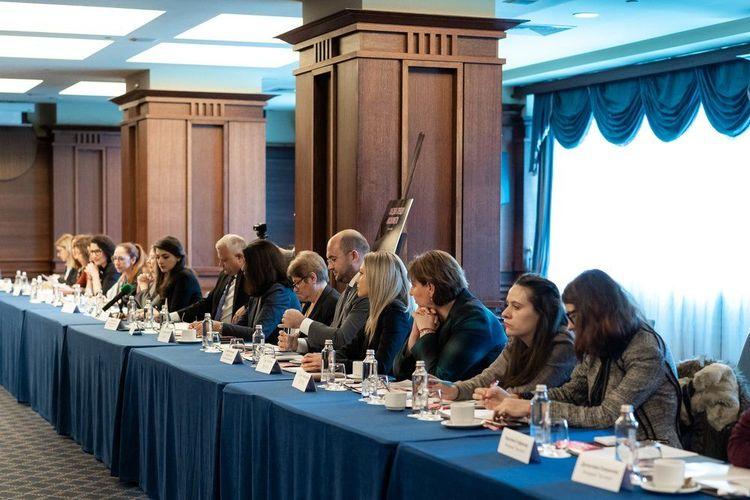
Coalition statement against changes to the Family Code
The NGO Coalition "Together Against Violence" has submitted a statement against changes to the Family Code signed by 28 civil society organizations, among which are the oldest and largest in the country.
To:
Ms. NATALIA KISELOVA -SPEAKERS OF THE 51ST NATIONAL ASSEMBLY OF THE REPUBLIC OF BULGARIA
infocenter@parliament.bg
With copy to:
Ms. ANNA ALEXANDROVA - CHAIRMAN OF THE COMMITTEE ON CONSTITUTIONAL AND LEGAL ISSUES
51_kkpv@parliament.bg
OPINION
From: NGO Coalition "Together Against Violence"
May 14, 2025
Subject: General bill with signature No. 51-553-37-21 of the adopted on 10.04.2025 on the first vote bill amending the Family Code, No. 51-454-01-50, submitted by Kostadin Todorov Kostadinov and a group of MPs on 19.12.2024; bill amending and supplementing the Family Code, No. 51-454-01-52, submitted by Alexander Viktorov Rashev and a group of MPs on 20.12.2024 and bill amending and supplementing the Family Code, No. 51-454-01-54, submitted by Denitsa Evgenieva Sacheva and a group of MPs on 20.12.2024, prepared on the basis of Art. 77, para. 2 of the Rules of Procedure for the Organization and Activities of the National Assembly
DEAR MS. KISELOVA,
DEAR MS. ALEKSANDROVA,
With this statement, the NGO Coalition "Together Against Violence" expresses its position and presents its proposals for changes to the general bill on amendments and supplements to the Family Code with signature No. 51-553-37-21, uniting the bills submitted by the PG "GERB-SDS", PG "Vazrazhdane" and PG "There is Such a People" adopted on the first vote on 10.04.2025.
With this statement, we unite the positions of non-governmental organizations engaged in the topic of domestic violence, human rights, and children's rights, and we express our willingness to participate in working groups in which the changes proposed here can be discussed.
In Bulgaria, shared parenting is practiced. It occurs between parents who have the necessary degree of mutual understanding and cooperation, who demonstrate maturity and the ability to control their emotions and distinguish their own desires from what is truly most beneficial for the child. It is practiced by parents who do not seek control or revenge against the former partner and where there is no evidence of a history of violence in the family environment. In most of the proposals, the bill actually reverses this situation.
There is a wealth of case law on the possibility of concluding an agreement for shared exercise of parental rights, which the court, on the basis of the current provision of Art. 49, para. 5 of the Family Code, approves after verifying whether it guarantees the best interests and legal certainty of minor children. The establishment of legal criteria for approving agreements and the elements for which it is permissible to reach an agreement for joint exercise should be extremely precise so as not to contradict the currently established case law, from which it is actually derived. In this regard, in Interpretative Decision No. 1/2016 of 03.07.2017 on item No. 1/2016 of the General Assembly of the Civil Chamber of the Supreme Court of Cassation, it is stated that the possibility of parental rights being granted for joint exercise by both parents in the event that an agreement on their exercise is not reached is excluded on the basis of Art. 59, paragraph 4 of the Family Code. It is this approach that should be accepted as the most appropriate and safest for children, since, as the Supreme Court of Cassation notes, no justice, no matter how fair and skillfully the judicial act is rendered, can be better for a minor child than the choice consciously made by the parents to overcome their personal contradictions, so that the child can truly draw from both parents, in peace and well-being, the resources necessary for harmonious development.
Given the above, we present and argue proposals for changes to individual paragraphs of the general bill with signature No. 51-553-37-21:
1. Regarding the proposed change in Art. 1 of the Family Code in §1 of the general bill:
It is proposed that Art. 1 of the Family Code regulate that the code, in addition to relationships based on marriage, kinship, adoption, guardianship and custody, also regulates the right to private and family life. We maintain that the right to private and family life, as a fundamental human right, regulated in Art. 8 of the European Convention for the Protection of Human Rights and Fundamental Freedoms and Art. 7 of the Charter of Fundamental Rights of the European Union, has a broad subject matter scope and it is not possible to regulate it through the Family Code, insofar as it is not limited only to issues concerning family law, but, on the contrary, covers non-exhaustive, various aspects, including the protection of personal integrity, the right to personal liberty, the protection of correspondence, the protection of personal data, as well as the right to protection against unjustified interference by the state, such as unjustified searches and detentions. Given the above, the amendment should be rejected.
2. Regarding the proposals in §2 of the general bill to create Art. 58a Family Code:
We accept that Art. 58a, para. 1 Family Code should regulate that parental responsibility is borne jointly by both parents, regardless of whether they live together or apart. We do not agree with the proposals in Art. 58a, para. 2 and para. 3 Family Code, which stipulate that important decisions for the child, such as his/her place of residence, education, extracurricular activities and planned medical interventions, are made jointly by the parents, and daily decisions - independently by each of them. In case of disagreement on issues such as the choice between football and sports dancing, following the approach set out in the bill, the dispute should be resolved by the court. This is associated with legal costs and a long time for its resolution, in which the child remains without access to the desired or necessary activity. Furthermore, such a regulation opens up the possibility of pressure from the parent with greater opportunities, who may abuse the right by systematically initiating cases, not in the interests of the child, but for the purpose of dominance.
Art. 58a, para. 4 Family Code stipulates that “The child’s time is shared between both parents, regardless of whether they live together or apart. In the event of a dispute regarding parental rights and the regime for personal contacts between a parent and a child, the time that the child spends with either parent cannot be less than 127 days on an annual basis, in case the parent does not endanger the life and health of the child”. The proposal should be categorically rejected. The fixed 127 days for one parent, regardless of the age of the child and the distance between the parents, ignores the need for an individual approach according to the specific situation, which is detrimental to the best interests of the child. For example, a nine-month-old infant should be handed over to the father, regardless of how far he lives from the mother. For comparison, in the Netherlands, the so-called "Alternating residence of the child" is only permissible if both parents live within 10 km of each other, in Belgium the average distance between a child and a non-resident parent should be up to 17 km.
3. Regarding the proposed options for amendments to Art. 59 of the Family Code in §3 of the general draft law:
3.1 Of the three options for amendments to the provision, the only one that can be supported is that of the PG "GERB-SDS", with the exception of Art. 59, para. 6 of the Family Code, which provides that in the event of evidence that parental alienation is present, the court shall hear an expert - a psychologist. First of all, this is a complex psychological and emotional state of the child, which, however, is not a scientifically established medical or psychiatric term, nor is it officially recognized as a diagnosis. The expert should answer specific questions formulated by the court regarding the psychological state, the relationship between the child and the parent, the needs of the child, but not on the issue of whether or not there is "parental alienation". This is an evaluative concept, without a legal definition, which the court should analyze on its own, based on all the evidence collected, not just an expert opinion.
In addition to the above, we believe that when introducing a rule for mandatory hearing of an expert, data on domestic violence should also be covered. Moreover, the proposal suggests not appointing just any expert psychologist from the lists of the courts, but someone who knows these issues and their specific features. At this stage, it is not possible to effectively provide the justice system with a sufficient number of expert psychologists who are proven specialists in these areas. At the moment, the requirement of Regulation No. H-1 of 14.02.2023 for additional qualification in “medical psychology” of experts is not being met due to an acute staff shortage. The court will be forced to hear psychologists without the necessary special knowledge, which leads to a serious risk of an insufficiently clear and objective assessment of the best interests of the child. In the remaining parts, Option No. 3 of §3 of the general draft law should be adopted, insofar as it alone reflects the principles already developed sufficiently consistently in case law.
3.2 Option No. 1, proposed by the PG "Vazrazhdane", cannot be supported categorically, because, if no agreement is reached, Art. 59, para. 2 of the Family Code sets out an exhaustive list of criteria for assessing the best interests of the child, which limits the court in each individual case. Art. 59, para. 3 of the Family Code establishes a minimum period of 10 days per month that the child must spend with the parent with a regime of personal contacts, and Art. 59, para. 4 of the Family Code adds that an exception can be made only up to 6 months, if the need for implementing protective measures is established or when the interest of the children requires it. The arguments stated in the above point are applicable - fixing a minimum period is too general and inflexible an approach, but in addition, the six-month period may lead to premature renewal of contact with a parent who is unable to maintain a safe and full-fledged relationship with the child. Very often, restoring a stable environment and building trust requires a significantly longer period.
Option No. 2, proposed by the PG "ITN" is also completely unacceptable and inadmissible. According to Art. 59, para. 1 and para. 2 of the Family Code, as proposed in the specified version, in the event of a divorce, if the parents conclude an agreement, it shall be approved by the court under Art. 49, para. 5 of the Family Code, and in the event of separation, this shall be done through notarial certification of the content and signatures. Notaries are not obliged to verify whether the agreement meets the best interests of the child, as the court is obliged to do. That is, from the point of view of guaranteeing their highest interests, there is inequality between children whose parents have entered into a civil marriage and those whose parents have not. In addition, at any subsequent moment and with ease, the consent of one of the parents can be withdrawn subject to compliance with the specified form, which introduces legal uncertainty in relation to the child.
3.3 Among the most drastic problems in the general draft law is the proposal of the PG "ITN" in relation to Art. 59, para. 6 Family Code, which introduces a rebuttable presumption of shared parenthood, as the text states: "In the absence of an agreement between the parents, the court determines the time and order for each of the two parents to bear parental responsibility, by mandatorily distributing, according to the circumstances, the child to live with each of the two parents, including during school holidays, official holidays and the child's personal holidays. Early childhood, the great geographical distance of the place of residence of the two parents and misunderstanding between the parents are not sufficient circumstances to rebut the presumption of shared parenthood." First of all, there cannot be a presumption, rebuttable or not, in relation to a concept without a legal definition, as is the case with shared parenthood. It is not clear what it covers, what its limits and elements are, that is, it is not clear what exactly is being disputed and, therefore, how the burden of proof is shifted in general. But even more so, the best interest of the child should always be assessed on the basis of a comprehensive assessment of each individual case and its individual specificities, and not by imposing constructions that deprive the court of discretion, such as the presumption of shared parenthood. By imposing equal periods in which the child should live with each parent, a number of key factors are not taken into account, such as the child's age, his opinion, his relationship with each parent, parental qualities and capacity, the distance between the parents' homes, the inability to register the child's current address, school attendance and extracurricular activities, the constant moving of belongings and, above all, the impact that this could have on his psycho-emotional state, the distortion of the sense of home.
Next, this text will directly lead to abuses by initiating proceedings under the Protection from Domestic Violence Act in order to rebut the presumption, insofar as it is not rebutted by the presence of the most prima facie argument against shared parenting, namely the lack of understanding between the parents. The next direct consequence will be the excessive involvement of the Child Protection Department and the bailiffs in the country with incessant conflicts regarding the child's handover, which will definitely significantly harm his/her mental and emotional state.
When rebutting a presumption, although it is not clear how, Article 59, Paragraph 7 of the Family Code regulates that the court shall nevertheless distribute the child's time with each parent so that the child lives no less than 127 days per year with each of his or her parents, if a parent does not endanger the child's life and health, which again does not take into account the need for an individual approach.
The proposal in Art. 59, para. 5, item 2 of the Family Code to require a court permit for travel by one parent and the child for more than a month and after a guarantee for the return of the child is lodged in the amount of at least double the costs of returning the child under the Hague Convention on the Civil Aspects of International Child Abduction contradicts the prohibition in Art. 22 of the Hague Convention. It seems that the aim is to secure in advance, through a legal norm, the fees of lawyers specializing in these proceedings, which is unacceptable.
It is completely unacceptable to support the proposal in Art. 59, para. 9, sentences two and three of the Family Code regarding the non-payment or payment of double the amount of child support depending on whether the parent managed to spend the allotted time with the child. Failure to pay support on the indicated grounds is a sanction for the child and clearly contradicts his interests. The function of support is to ensure the living conditions of the child, such as they had before the divorce of the parents, unless this would create special difficulties for the parent who owes support. Support for children is owed by both parents, regardless of who they live with, but the custodial parent should, in principle, bear a smaller share of the support in cash in view of the support provided by him in kind when living together with the children and meeting the household expenses, some of which are also for the benefit of the children.
In connection with the proposal under Art. 59, para. 10, para. 11, para. 12 Family Code, it has already been substantiated that it is not possible to effectively provide the justice system with a sufficient number of experts who are proven specialists in the issues of parental alienation specifically, and that the subject scope of such regulation, including the imposition of measures to change the parent's behavior, should include data on domestic violence.
4. Regarding the proposed amendments to Art. 123, para. 1 of the Family Code in §4 of the general draft law:
The proposal can be supported.
5. Regarding the proposed new provisions of Art. 126, para. 4-6 Family Code in §5 of the general draft law:
The proposed amendments clearly show that the draft law places emphasis on formal equality between parents, instead of proceeding from the principle of the best interests of the child. Therefore, they should be rejected. The specified provisions impose a universal approach, without taking into account the individual characteristics of each family situation. With Art. 126, para. 6 Family Code, if there is no consent to move the child to a distance of more than 100 km, even when the change is clearly in the child's interest, there is a risk of blocking important decisions, preconditions for conflicts, involvement of bailiffs and emotional stress for the child. In addition, such a requirement can easily be used for manipulation or control, whereby the child becomes a means of pressure.
6. Regarding the proposed changes to Article 131, paragraph 1 of the Family Code in §9 of the general draft law:
The proposed provision provides that in the event of a parent’s behavior that creates a risk of parental alienation or leads to such, the court may restrict parental rights or assign them to another person. The text should be rejected because it creates prerequisites for sanctioning, without providing sufficient procedural guarantees or clarity on how parental alienation will be established. As stated, unlike clearly defined conditions such as anxiety, post-traumatic stress disorder or depression, there are no established clinical scales or standardized tests regarding parental alienation, through which its presence can be proven with the necessary degree of scientific reliability and objectivity. The practice of the Supreme Court of Cassation emphasizes that restricting parental rights is a measure of last resort, applicable only in the event of a real and proven danger to the child. There is a lack of focus on prevention, awareness and support for families – elements that are critical to addressing alienation. Instead of protection, a new form of pressure and instability is created in the child’s life. With good intentions, the legislator would provide provisions obliging parents to attend programs that eliminate alienating behavior at an early stage and increase parental capacity.
7. Regarding the proposals in §10 of the general bill:
The proposal should be adopted.
8. Regarding the proposed amendments to the Civil Procedure Code in §11 of the general draft law:
The proposed options for amendments are two, and only the second, by the GERB-SDF parliamentary group, can be supported. The option proposed by the ITN parliamentary group must be rejected, as it contradicts fundamental principles in civil proceedings such as the grounds for suspension, resumption and termination of proceedings, the rules for joining claims, the possibility for the parties in the proceedings to provide explanations, the introduction of indefinite pendency, justified by the addition of different claims in one case, without taking into account the stages, preclusive and limitation periods in the proceedings, nor even the consequences of the issuance of a decision at first instance and the impossibility of the case continuing to be pending for an indefinite period, while at the same time there is a period for appeal before a second instance and, respectively, for appeal proceedings to be initiated afterwards. In addition, the proposal in Art. 330a, item 3 of the Civil Procedure Code, to subject cases under the Protection from Domestic Violence Act to the general "special proceedings" is legally and practically unjustified, as it ignores the nature of the Protection from Domestic Violence Act as a special law in relation to the general norms of the Civil Procedure Code, which introduces rules for expedited proceedings, the possibility of imposing immediate protection measures, a different standard of proof and a different distribution of the burden of proof, which take into account the specifics of this type of assault.
9. Regarding the proposed amendments to the Criminal Code in §12 of the general draft law:
The proposal should be rejected. Art. 182, para. 2 of the Criminal Code provides for criminal liability for failure to comply with a court decision regarding the exercise of parental rights or personal contacts with a child. The proposed version of the provision provides for a drastic increase in the punishment in particularly serious cases – from the current maximum of six months of imprisonment to up to five years, in order to “strengthen general prevention”. Such an amendment, however, contradicts the principle of proportionality of punishment. Depriving a parent of liberty in such a case does not lead to the restoration of relations between the child and the other parent, but on the contrary – creates even deeper alienation, stigmatization and psychological trauma. Increasing the punishment to five years of imprisonment essentially equates failure to comply with a court decision to serious intentional crimes against the person, without objectively existing a comparable risk to the life or health of anyone.
10. Regarding the proposed amendments to the legal definition of domestic violence under the Protection from Domestic Violence Act in §14 of the general draft law:
An addition is proposed to Art. 2 of the Protection from Domestic Violence Act, which qualifies as a form of mental and emotional violence “the thwarting, in any way, of the right of a child and a parent to family life, as well as the right of the child to maintain regular personal relations and direct contact with both parents”. The amendment should not be allowed. There are no legal definitions of key concepts such as “direct contact”, “regular personal relations” and “separation from a parent”. It is not specified, for example, whether “direct contact” means only physical meeting or also includes other types of communication. For example, a parent who works abroad and for this reason cannot meet with their child monthly, cannot be defined as an “abuser” on the grounds that the contact is not “regular” or “direct” according to unclearly defined criteria.
11. Regarding the proposals in §15 of the general bill to repeal Art. 65 of the Law on the Ministry of Internal Affairs:
The proposal in the final provisions of the bill to amend the Family Code, which provides for the removal of the possibility of issuing a warning protocol by the police authorities, must be rejected. The warning protocol, issued under the Law on the Ministry of Internal Affairs, is an official document drawn up by an official within the scope of his official powers and according to an established procedure. This tool, which is used in the presence of sufficient data for the potential commission of a crime or violation of public order, has an important preventive function not only in the context of domestic violence, but also in a number of other areas - including hooliganism, conflicts in the community, anti-social behavior by minors and others.
In summary, after a careful analysis of the general bill amending and supplementing the Family Code with signature No. 51-553-37-21, uniting the proposals of the GERB-SDF, Vazrazhdane and Ima takvi narod (There is a People) groups, we express the following reasoned position: Based on a large part of the proposals for amendments to the Family Code, it is evident that there is a lack of in-depth preliminary analysis and participation of experts from various professional fields familiar with the specifics of the matter related to the best interest of the child, his or her mental development and inter-institutional coordination in this regard. As such, we are categorically against a significant part of the proposals. A rebuttable presumption of shared parenting is imposed, without it being defined in terms of content, elements, applicability and boundaries, without taking into account that in the presence of parental conflict or a history of violence, such a regime can increase tension and harm the child. Nowhere is there a clear exception that in the event of data on domestic violence, this regime is absolutely inapplicable. Next, it is proposed to introduce legal regulation on “parental alienation”, although this term has no established scientific or legal content, is not recognized in the international classifications of mental disorders (DSM-5, ICD-11), has been rejected by the WHO and there is no single definition for it. It is not taken into account that domestic violence is explicitly defined in the current Bulgarian legislation, being subject to special legal regulation through the Protection from Domestic Violence Act. Any legislative initiative that affects the consequences of domestic violence (including when exercising parental rights) should be in line with the Protection from Domestic Violence Act, and not bypass or replace it through the proposed changes to the Civil Procedure Code.
After analyzing the general bill with signature No. 51-553-37-21, we support the proposals that reflect the principle that every parent bears parental responsibility and are consistent with established case law – such as Art. 58a, para. 1 of the Code of Civil Procedure, option No. 3 of §3, §4, §10 and option No. 2 of §11 (PG "GERB-SDF").
At the same time, we cannot support and oppose the provisions that create risks and legal ambiguity, namely:
- The proposal for mandatory joint decision-making (Art. 58a, para. 2–3 Family Code) leads to the risk of pressure through legal proceedings and blocks the child's access to various activities until a final court ruling;
- The fixed 127 days (Art. 58a, para. 4 and Art. 59, para. 7 Family Code) do not take into account the need for an individual assessment of the best interests of the child in each individual case;
- The rebuttable presumption of shared parenthood (Art. 59, para. 6 Family Code) is unclear in scope and dangerously limits judicial discretion, even in the presence of serious conflicts, which will lead to traumatization of children and abuse of the law;
- The requirement for a financial guarantee when traveling (Art. 59, para. 5, item 2 Family Code) contradicts Art. 22 of the Hague Convention on the Civil Aspects of International Child Abduction;
- Linking maintenance to the regime of personal relations (Art. 59, para. 9 Family Code) directly punishes the child and violates the basic principle of ensuring his needs;
- The excessively high penalty of up to 5 years of imprisonment (Art. 182, para. 2 Criminal Code) is disproportionate to the nature of the offense and damages the parent-child relationship;
- The expansion of the definition of psychological violence against a child and a parent, as indicated by the proposed new provision of Art. 2, para. 3 of the Protection from Domestic Violence Act, is unclear, easy to manipulate and ignores real-life circumstances;
- The removal of the warning protocol (Art. 65 of the Law on the Ministry of Internal Affairs) would take away an important preventive tool in cases of tension, including domestic violence.
Given the above, we call on the legislator to specify the scope and content of the bill, ensuring that the changes proposed here will be discussed in working groups to which we will be invited. Our goal is to achieve a bill in accordance with the principle of the best interests of the child, with the system of Bulgarian substantive and procedural law and with Bulgaria's commitments under international treaties in the field of human rights and the rights of the child. We believe that instead of dividing the child equally, the law should place emphasis on preventing parental conflicts by working with parents on programs that increase their parental capacity, when necessary.
In this sense: Decision No. 74 of 07.04.2016 on case No. 4369 / 2015 of the Supreme Court of Cassation, 4th city department; Decision No. 158 of 28.06.2016 on case No. 3316 / 2015 of the Supreme Court of Cassation, 3rd city department; Decision No. 291 of 04.01.2016 on case No. 2320 / 2015 of the Supreme Court of Cassation, 3rd city department; Decision No. 334 of 06.01.2016 on case No. 2202 / 2015 of the Supreme Court of Cassation, 4th city department; Ruling No. 239 of 15.02.2013 on Civil Case No. 1048/2012 of the Supreme Court of Cassation
Signatories of the NGO Coalition “Together Against Violence”:
1. Animus Association Foundation
2. Alliance for Protection from Gender-Based Violence
3. Bulgarian Fund for Women
4. Bulgarian Helsinki Committee
5. The Wake Up Foundation
6. Demetra Association
7. Bulgarian Platform European Women’s Lobby
8. Pulse Foundation
9. SOS Children's Villages Bulgaria Association
10. H and D Perspectives Foundation
11. Demetra Association, Center for Crime Prevention - Sofia
12. Mission Wings Foundation
13. LGBTI organization Action
14. Foundation to help women who have suffered violence - Fly - love yourself first
15. Impact Drive
16. Women of Kazanlak Association
17. Informal collective "Feminist mobilizations"
18. National community center "Ivan Vazov - 2014"
19. Levfem Association
20. Mama has a job Foundation
21. Bulgarian Foundation for Business and Human Rights
22. Kikimora and Kikimora Foundation
23. Self-Mastery Center
24. Civic organization against mandatory shared parenting
25. Queer Varna Foundation
26. NGO "Young, active, creative”
27. NGO "Orion - Care for Leaders and Authorities"
28. Civil Society Group: Stoyka Atanasova, Lina Yosifova, Galya Dimarova, Alexandra N., Kristina Tonkova, Lachezar Ninkov, Iva Stamova, Stella Staykova, Ekaterina Veleva, Margarita Radenkova, Maria Peeva, Madlena Yordanova